Start with the contact patch, not a product category
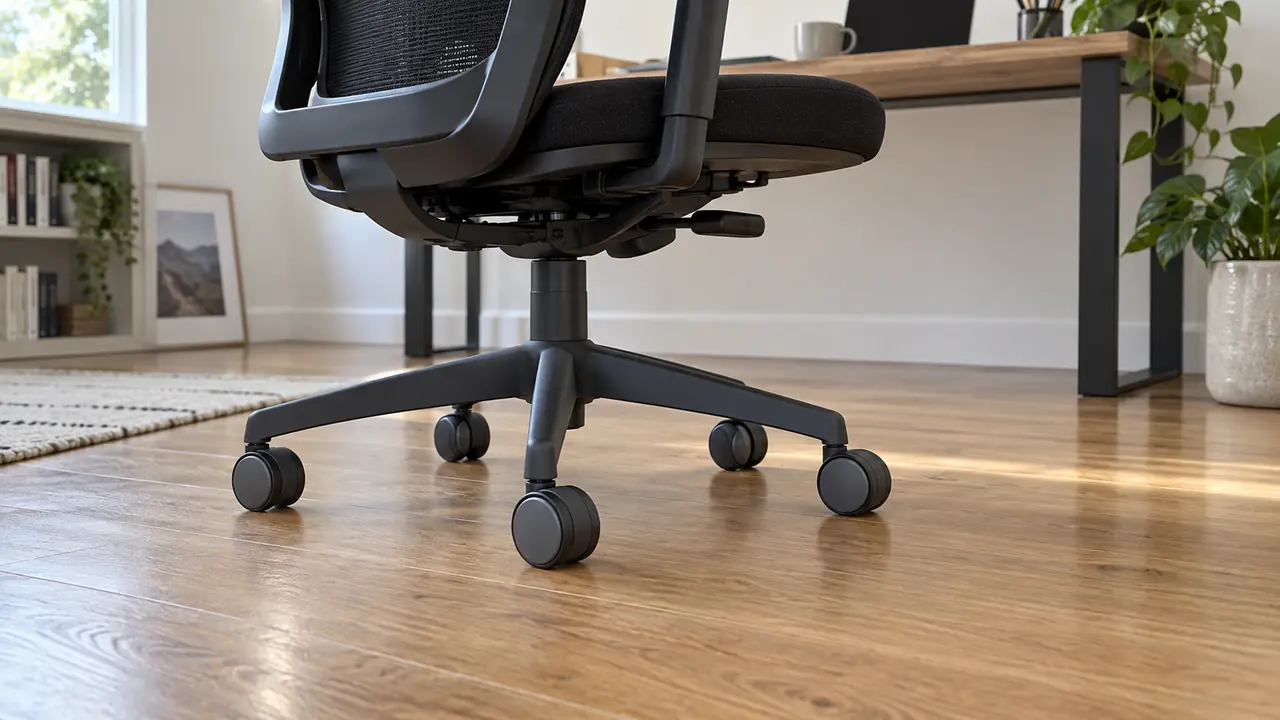
A rolling chair meets hardwood through a small moving contact patch. That patch carries the wheel's tread, whatever grit has collected around it, the chair's load, and the particular finish on the plank below. Looking only at a label such as soft, rollerblade, or rubber loses most of that relationship. I begin by asking where the chair moves, how often it pivots, whether the floor has seams or a rug edge nearby, and whether the wheel already carries debris. Those observations make the rest of the decision more specific than a generic promise about safe wheels. For a broad product-format question list, this non-marking rubber caster reference can help identify the dimensions and material details that still need to be compared with the actual chair and room.
Use a reference as a question list
Rubber chair casters still need the right stem type, dimensions, and load rating for your chair. Check the chair manufacturer’s replacement guidance and the flooring maker’s care instructions before choosing a wheel material. Wheel diameter can change seat height and clearance beneath the base. Keep wheels free of trapped grit, since a non marking label does not guarantee that every hardwood finish will remain untouched.
Treat non-marking language as a limited clue
Non-marking normally describes the wheel's tendency not to leave obvious colored residue under ordinary use. It does not describe every source of marking in a workspace. Dust, grit, a rough threshold, a damaged finish, a metal fragment in a tread, or repeated hard pivots can all change what reaches the wood. A dark wheel may also hide dirt more readily than a pale one, which makes visual inspection less automatic. The useful response is to connect a tread claim to a cleaning habit and a route inspection instead of assuming a material word ends the inquiry.
Read the floor as a working surface
Hardwood is not a single condition. Factory-finished boards, site-finished planks, older sealed floors, and recently refinished areas can respond differently to soil, moisture, sunlight, and traffic. Look for dull lanes, rough seams, loose debris, raised transitions, and places where the chair pauses to turn. That survey does not diagnose a finish or replace the floor maker's instructions. It gives the caster decision a real setting. If the floor already has a concern that is unrelated to the chair, a new wheel should not be presented as a repair for it.
Compare wheel geometry beside material
A wide soft tread can distribute a chair's movement differently from a narrow hard contact edge, but diameter and hood shape matter as well. A larger wheel may roll over a small seam with a different feel; a wide hood may need more clearance around the chair base; a wheel that looks substantial can still gather hair at the axle. No single geometry is universally preferable. The productive comparison asks whether the wheel can turn freely, clear the base, pass the actual route, and remain easy to inspect. Those are practical constraints, not claims of guaranteed protection.
| Observation | Useful question | Do not infer |
|---|---|---|
| Soft or non-marking tread claim | What material and dimensions are actually stated? | Universal floor protection. |
| Visible grit near a wheel | Where is it entering the room or route? | That tread material alone caused a mark. |
| Rug edge or threshold | How often and at what angle does the chair cross it? | Any replacement will erase the transition. |
| Unclear stem or socket | What does the chair maker specify? | A near visual match is safe to force. |
Map the route that really happens
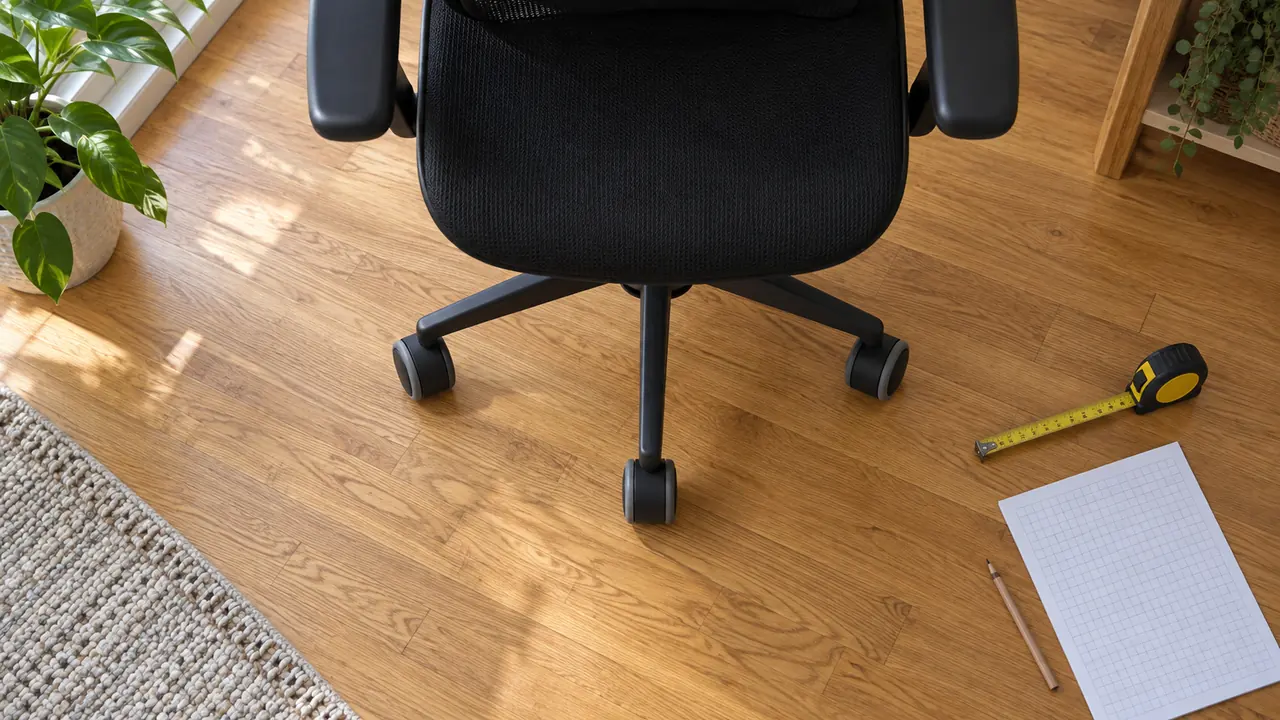
Most desk chairs repeat a few movements: sliding toward a keyboard, pivoting to a file drawer, backing away from a desk, and turning toward a door or shelf. Draw those routes on a rough room sketch. Include a rug edge, a cable, a floor vent, a threshold, and the place where the chair changes direction most sharply. A wheel that feels smooth in a straight demonstration may behave differently when it meets a transition at an angle. The map makes it possible to improve the route, relocate an obstacle, or limit a problem area without treating the caster as the only variable.
Make compatibility a stop gate
A caster cannot perform a useful job if its stem does not match the chair socket or if its hood interferes with the base. Measure and inspect the existing hardware before ordering. If a chair has a nonstandard retention method, a damaged socket, or a stem that does not correspond to the candidate's stated fit, pause rather than forcing a close-looking part. A forced change can create a stability or damage issue that has nothing to do with hardwood. Exact compatibility information from the chair maker or a suitable furniture-service professional is more valuable than a confident guess based on a photograph.
Use a modest before-and-after check
After a compatible change, keep the first check ordinary. Roll the empty chair along its normal path, turn it where it usually turns, and look underneath for obvious clearance or debris problems. Then use the chair during a few typical work sessions and inspect the wheel treads and floor route in normal light. Do not turn a short observation into a claim about long-term floor performance. Its value is narrower: it can show a wheel that binds, a rug edge that catches, a chair base that crowds the hood, or a cleaning need that was easy to overlook.
Keep the wheel-floor boundary clean
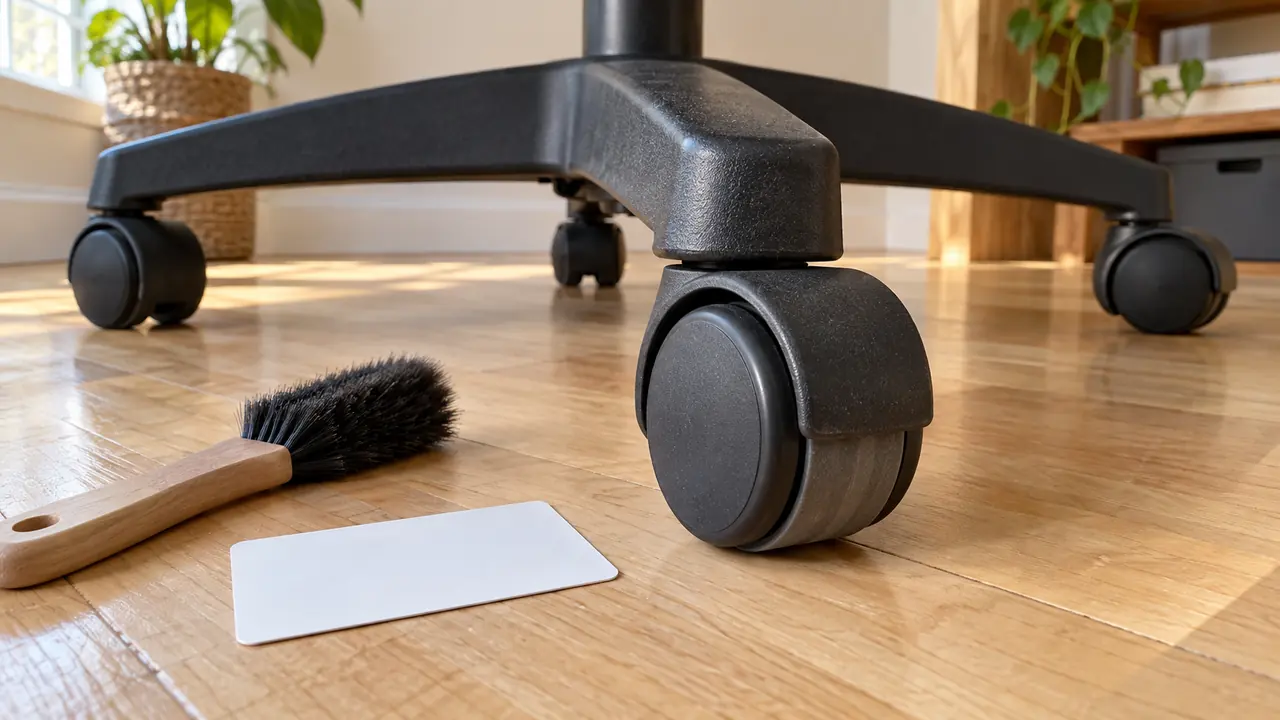
Tiny particles do not stay politely beside a desk. Paper fibers, grit brought in on shoes, pet hair, and fragments from a rug can travel into a caster hood and become part of the contact area. A quick visual check when vacuuming or clearing the desk is often more useful than an elaborate maintenance ritual that never occurs. Wipe or remove debris with a method suitable for the chair and floor, and follow the floor's own care guidance for cleaning products. Avoid presenting a wheel as permission to use moisture or cleaners that the finish maker has not approved.
Decide what the caster is not meant to solve
Casters do not correct a loose plank, a wet-cleaning problem, a structural chair defect, a badly placed cable, or a floor finish concern that needs primary guidance. Naming those limits keeps a simple office accessory decision proportional. When the room is mostly clear, the chair is compatible, the route is considered, and the treads are kept free of debris, a non-marking rubber option can be evaluated on its stated traits rather than its marketing mood. The result is a calmer decision: select a suitable component, then keep observing the boundary where furniture and floor meet.
Before a caster earns the chair
Use the questions as a room-and-hardware check, not as a substitute for maker or floor-specific guidance.
- Record the existing stem and socket details.
- Map the common roll and turn path.
- Check clearances around every base arm.
- Read floor-care guidance already available.
- Keep grit and rug fibers out of the route.
- Stop when fit or repair information is uncertain.
Give the choice a documented reason
A decision note does not need a rating system or a claim of laboratory certainty. It can state that the chair's stem was checked against the component information, the housing cleared the base arms, the floor route was swept, and the most-used turn did not involve a loose rug edge. Those details explain why a candidate is plausible for this setting. They also make later review more honest: if a concern appears, the room facts can be revisited instead of imagining that a material label promised something it never stated.
Keep the review connected to ordinary work
The final measure is whether the chair can be used normally without hiding a mismatch. During regular work, check that the wheels turn, that the route remains clear, and that accessible treads do not collect a surprising amount of debris. If the room changes—new rug, different desk position, pet activity, floor work, or a chair repair—read the setup again rather than assuming an old conclusion applies forever. This approach is deliberately modest. It gives rolling furniture a place inside normal room care without assigning it responsibility for the entire condition of hardwood.
Use uncertainty as useful information
A listing may omit stem details, a chair may have undocumented hardware, or the floor may show a condition that cannot be interpreted from a room-level look. In those cases, uncertainty is not an inconvenience to be written away. It identifies the next source of information and prevents an unnecessary force-fit or cleaning experiment. A careful pause can preserve the chair, the floor, and the option to return an unopened component. Good selection practice includes knowing when the available evidence has reached its limit.
Leave the room readable
The strongest outcome is a room where the caster, chair, floor, and route can each be discussed in their proper scale. A compatible assembly is only one part of that picture. Keep the path open, notice accessible debris, preserve the original hardware until a change is settled, and use product or floor information for the questions it is equipped to answer. This final note does not offer a universal buying verdict. It offers a way to keep a small rolling-furniture choice connected to the real hardwood room where it will be used.
Previous publication in the sequence
For the preceding publication, see Nookwork Atlas on corner-desk monitor risers. This is a chronological publication link, not a topical recommendation or a claim that either article validates the other.
Consider Laptop Screen Privacy Separately
Floor protection does not address visibility of your work. For that separate concern, the next guide covers privacy screens for Dell XPS 13 laptops, where the exact display version and attachment style matter.